Replace Deadly Pesticides such as Terbufos in South Africa
The tragic deaths of several school children in Soweto in October 2024 sparked a government led investigation into the cause as all children had allegedly consumed food and snacks from local Spaza tuck shops. Investigations revealed the food contained traces of the organophosphate pesticide Terbufos, commonly used in agriculture, but also widely used in townships as a cheap and readily available poison for rodent control. Can we replace deadly pesticides such as Terbufos in South Africa with alternate chemicals such as the sulfuryl fluoride fumigant, ProFume?
What is Terbufos?
Terbufos is a highly hazardous pesticide classified by the World Health Organization as a class 1a organophosphate pesticide. It was banned in the EU in 2009. In the Southern African Development Community, it is banned in Angola, the Comoros, Botswana, the Democratic Republic of Congo, Madagascar, Malawi, Mauritius, Mozambique, Namibia, Seychelles, Tanzania, Zambia and Zimbabwe. It is not banned in South Africa and is still widely used in the agricultural sector. Citrus and wine farms, maize, wheat and sugarcane plantations use Terbufos frequently.
The Toxic Effect of Terbufos
Terbufos has neurotoxic effects and is particularly dangerous to children and adolescents. The agrichemical is considered to have a higher potential to harm public health, the environment, wildlife or other crops, compared with other pesticides. Due to its extremely toxic and hazardous nature, Terbufos has been banned for use in many parts of the world.
Root Knot Nematodes
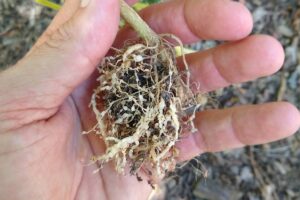
Soil treatments using alternate pesticide chemicals

The use of Terbufos in South Africa
Despite its extreme toxicity, Terbufos is widely and commonly used in the agricultural sector in South Africa. Its sale and access is highly controlled. It was classified in terms of applicable regulations as a “restricted pesticide” in 2023. Farmworkers are exposed to and vulnerable to the highly toxic pesticide as it is often used without the necessary protective gear.
In the townships, informal settlements and at taxi ranks, it is known as “halephirimi”. Translated to mean ‘you will never see the sunset’, halephirimi lives up to its promise and guarantee. It is highly toxic, lethal and fast acting. At any street corner in townships and informal settlements, one can easily find the small black bag of granulated poison. It is almost always in the translucent, unmarked, small packet used for packaging ‘amakipkip’ and other snacks loved by children. It has three main uses in townships: suicide, dogs and rats.
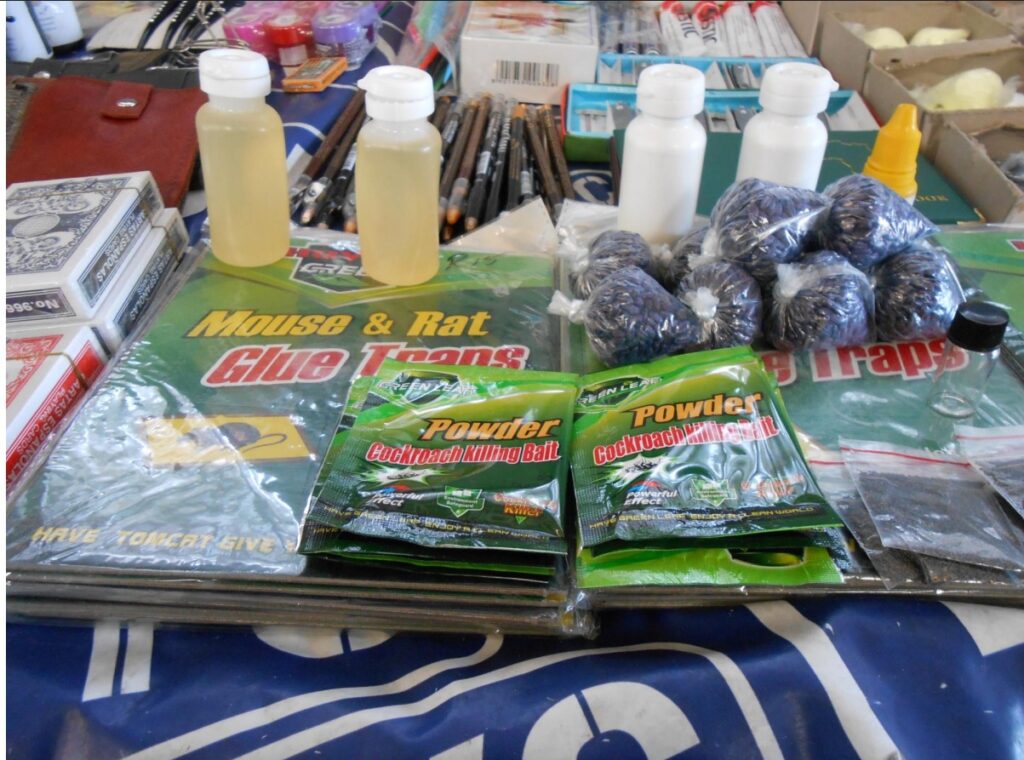
The Gauteng health department reports that halephirimi is a popular choice for those attempting suicide, particularly in the townships. Criminals, such as burglars, rub halephirimi on pieces of meat to quickly kill guard dogs. But its most common use is to kill rats which have become an endemic problem in townships. Poor waste management in several municipalities has propegated this issue. Rubbish is not collected, streets are not cleaned and rodent infestations thrive in such conditions.

Government Responses
Delivering government’s comprehensive response to the reported cases last November,Ramaphosa presented Cabinet’s decision of a three-pronged intervention strategy:
- Get hazardous pesticides off the street
- Protect children from exposure
- Prevent future outbreaks.
Last December, the African Centre for Biodiversity and a coalition of farm workers and civil society organisations petitioned Agriculture Minister John Steenhuisen and the registrar, in terms of Act 36 of 1947, “ to ban the acquisition, disposal, sale, or use in any form of the registered agricultural remedy known as Terbufos”.
In his response, Steenhuisen said: “It’s very easy for these organisations to stand on a soapbox and say,’immediately ban it’ … [but there are] broader implications for the agricultural sector, not least around food security.” T
The minister also cautioned against possible huge crop failures, pest infestations and food insecurity if the pesticide is banned without appropriate alternatives.
Can we replace deadly pesticides such as Terbufos in South Africa?
The efficacy of sulfuryl fluoride (ProFume Fumigant Gas) is well established for use in enclosed areas such as grain silos, wooden structures and containers for export. Its use in postharvest stores and distribution chains is inequivicable.
A German patent application from Bayer CropScience AG in 2003 looked at sulfuryl fluoride to be used as a soil fumigant for disinfecting soil or as a product for controlling soil-borne, plant-damaging nematodes, insects, fungi and bacteria and for controlling unwanted plant growth. Their mechanisms of treatment included injecting into the ground using stationary or mobile devices. The soil was mechanically compacted or covered during and after treatment. They also experimented with injecting the compound under a film covering the ground or by drenching the ground.
Sulfuryl fluoride was found to be surprisingly highly effective against plant pathogens. Nematodes could also be controlled including the ‘ice stage’ where the eggs remain dormant but viable under winter snows (Europe) or frost. As with other pests, the complete life cycle is addressed using sulfuryl fluoride.
Certain regions in China find the use of Sulfuryl Fluoride as a soil fumigant against root-knot nematodes and other key soil pathogens to be an economically viable alternative to methyl bromide use in similar applications.
Although the mechanism of action of SF means it is effective against rodents in confined areas such as warehouses and food stores, using it to combat the endemic problem of rat infestations in urban and township areas is not possible. Rat control requires a comprehensive management plan involving strict adherance to municipal waste management protocols.
Can Sulfuryl Fluoride replace Terbufos in the Agricultural Sector?
The results are promising that, like other countries in Africa, Terbufos can and should be banned as quickly as possible in South Africa to avoid tragic deaths. However, finding complete and viable solutions to replace its use in the agricultural sector will require additional governmental controls and legislation. Labelling SF for use in the agricultural space requires registration for such in the annals of government, and that, unfortunately, is an expensive and time consuming undertaking.