When Pesticides No Longer Work
What can you do when conventional pest control techniques cannot stop a persistent pest problem that is threatening food safety and quality? When pesticides no longer work, alternate treatment remedies must be sought. Protect your consumers, workers, profits and brand by educating yourself on the right treatment for the right job.
Be the pest management company consumers want.
Government agencies are having a broader presence in the food industry. The majority of manufacturers are certainly trying to do the right thing, but often depend on a pest management company to guide them with regards to controlling threatening pest problems. But how many pest companies know how to properly monitor, identify and prescribe a treatment for the most challenging stored product pest issues? Integrated Pest Management is essential to irradicate the most persistent pest problems – and that includes understanding the efficacy and outcomes of different chemicals, protocols and techniques to get the job done.
Ed Note: Fumico offers complimentary ProFume Stewardship Training for those interested in improving their fumigation service offering.
Pesticide Resistance is a global problem

All life stages of pest must be controlled.
Understanding Resistance
Resistance is defined as a change in the sensitivity of a pest population to a pesticide. This means even the correct application of the pesticide fails to control the pest. Resistance can develop when the same pesticide or a pesticide with a similar mode of action are used over and over again.
It was presumed the pests changed or mutated to become resistant. However, it is not the individual pest (insect, weed, or microorganism) that changes, but the population.
When a pesticide is applied to a crop or treatment site, a tiny proportion of the pest population (for example, one insect or weed in 10 million) may survive exposure to the pesticide due to its genetic makeup. When the surviving pests breed, some of their young will inherit the genetic trait that confers resistance to the pesticide. Through subsequent generations, the less-susceptible individuals in the population increase.
A case in point: DDT
We saw this with the use of DDT on bed bugs during the second world war. DDT was used extensively to control pests within troop quarters from 1939. By 1940, bed bugs were already proving resistant to the potent chemical. After DDT was banned in 1972, people started using pyrethroid pesticides, like deltamethrin and lambda-cyhalothrin. Pyrethroids kill insects in a similar way as DDT. Both pyrethroids and DDT target the same part of an insect’s nervous system. Because of this, some bed bugs that were resistant to DDT were also resistant to pyrethroids, even if they had never been around pyrethroids before. This is called cross-resistance and is a contributing factor in our current resurgence of bed bug issues.
How a Professional Pest Controller Deals with Pesticide Resistance.
When the efficacy of a treatment drops, the pest controller will generally use higher rates and more frequent applications until the pesticide provides little or no control. This is NOT the way a professional pest controller will do things.
Identify your pest correctly
Older broad-spectrum pesticides may have worked on any living thing and didn’t require exact identification, but new chemistries are designed to kill
only the target pest and have less effect on beneficial insects.
Get the Timing Right
Timing is critical. Correct timing of a pesticide application can be the
difference between success and failure. New pesticide chemistries may
target only a certain life stage of the pest, like eggs or larvae, so timing the
application to the correct life stage is more critical than ever. Even with older
chemistries, contact insecticides may only be effective on a certain life stage,
like scale crawlers. It takes time to scout and determine exactly when the
crawlers are exposed but applying too early or too late will be a waste of time,
money and pesticide. Some pesticides should only be applied a certain number of times or amount per year, so you must time the application to maximize its effectiveness.
Sulfuryl Fluoride (ProFume) has proven efficacy on ALL life stages of pest but Research by the Queensland Department of Agriculture and Fisheries, with GRDC investment, has shown that effective control of all insect life stages with sulfuryl fluoride requires seven-day exposure for grain above 25°C, and 10-day exposure for grain between 20°C and 25°C. When grain is below 20°C, fumigation with sulfuryl fluoride is unlikely to be 100% successful as the insect life cycle is too slow, meaning the gas is not absorbed by the adolescents.
Coverage is Paramount
Coverage is another critical aspect of treatments. If the pesticide does not reach the target pest, it will be ineffective. This may not be critical with systemic pesticides, but it is important when using a contact pesticide.
Factors to consider when applying a contact pesticide:
- Are you applying too quickly?
- Are the droplet sizes/nozzles right for the application?
- If using an airblast sprayer, are the nozzles correctly selected and adjusted for the various levels of height?
- Is the wind blowing too much at the time of application?
- Do you need to add an adjuvant to alter the droplet size or spread?
We can all be lazy, but don’t let the importance of coverage escape your attention.
Factors to consider when applying fumigant treatments
All fumigants, including sulfuryl fluoride, require gas-tight sealable storage to effectively control insects at all life stages. Unsealed storages will not hold a high-enough gas concentration for a long-enough period of time to kill the eggs, larvae and pupae.
Unlike methyl bromide which can be sealed using regular duck tape, sulfuryl fluoride requires a specialised tape such as Fumico’s specifically engineered PINK TAPE.
Environmental Conditions
Wind and rain can wreak havoc on any pest treatment. Temperature extremes can inactivate chemicals or, as in the case of oil based chemicals, make it phytotoxic to the crop. Temperatures also effect the development of pests: cooler conditions slow the life cycle while warmer conditions offer a robust breeding, developing phenomenon. Cooler environments will need longer exposure times to irradicate pests through the entire life cycle.
Sulfuryl fluoride is a heavy gas at 3.7 times the density of the atmosphere. Most applicators will introduce the gas into the top of a storage, anticipating it will settle to the bottom. Best practice is to have some form of sealed recirculation system to gently transfer gas through the storage to ensure an even concentration throughout the grain bulk for the duration of the fumigation.
Without recirculation, it will take longer for the gas to reach all parts of the storage and, as it sinks, it will likely leave the top of the storage with a sub-lethal gas concentration.
Pesticide Storage
Unsuitable storage conditions can impact the quality of the pesticide and harm application effectiveness. Some pesticides, especially biologicals or biorationals, have stringent storage requirements and can be inactivated
above or below certain temperatures. Some pesticides were just not created
to maintain effectiveness if stored for too long or under conditions above
40° C – which many areas of South Africa can experience regularly.
Some pesticides have a use-by date. Pesticides should be stored on a “first-in, first-out” basis.
Sulfiryl Fluoride (ProFume Fumigant Gas) is classed as a hazardous chemical and therefore transportation and storage of cylinders are strictly controlled.
Rotate Chemical Treatments
Never rely on a single pesticide class. Rotate modes of action, especially
when there is more than one generation of the pest in a year. For example, rotating phosphine fumigation with sulfuryl fluoride will protect against the development of phosphine resistance. Read More about Sulfuryl Fluoride can break phosphine resistance…
Best Pest Control Practice
Your goal should always be to apply pesticides at the recommended rate with thorough coverage. Using a higher rate is illegal and may not be more effective. Using a lower rate can also be ineffective. Applying pesticides
without calibrating your equipment or checking the deposition uniformity can
be dangerous and wasteful.
“If at first you don’t succeed, try again” does not apply to pesticide applications of the same chemical. If control with a pesticide fails, do not retreat with the same chemical or another with the same mode of action.
Re-examine your checklist:
- Did you properly identify the pest?
- Did you use the correct dosage and timing?
- Is yourequipment properly calibrated and
do you have good deposition? - Were environmental conditions correct for
the application? - Was your pesticidequality still good and not out of date?
If you answer yes to all these, then try another pesticide with a different mode of action or a tank mix with two different modes of action. Pest resistance is something we all need to work together to avoid
Indian Meal Moth Infestation (Plodia Interpunctella)
The principal sign that you have an Indian Meal Moth Infestation is a thick blanket of silk webbing over your stored food product. This is a common pest infesting homes and grocery stores alike. The larvae are general feeders and can be found in grain products, seeds, dried fruit, dog food, and spices.
The Indian Meal moth received its common name in the United States where it was found to be a pest of meal made of “Indian corn” or maize.
Identification
The wings of these adult moths are quite distinctive with 2/3 of the lower wing a striking copper/bronze colour and the 1/3 of the wing closest to the head is off-white to greyish in colour. The wings are folded over the abdomen when at rest.
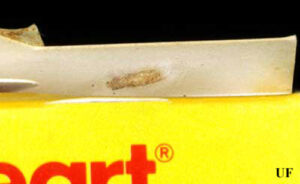
The fully grown larvae produce silk webbing and cocoons which can often be detected in the vicinity of the food commodity the larvae feed on.
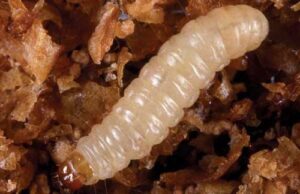
Larvae are large in size and creamy white with a brown head. The Adult life span is 10-14 days. Adults are about 13 mm in length.
Adult Indian Meal Moth

Larvae
Biology
Adult female moths lay between 200 and 400 ova (ivory coloured eggs) in or on food commodities. The larvae are creamy white with a brown head. When fully grown and mature (after 21 days) they will wander off and spin cocoons away from the infested food commodity.
The larvae pupates inside the cocoon. Adult moths emerge from the cocoons after 7 to 10 days.
Symptoms of Damage
Besides infesting all cereal food products and whole grains, larvae also feed on a wide variety of foods and feeds such as dried fruits, powdered milk, cornmeal, flour, raisins, prunes, nuts, chocolate, candies, health food and seeds, bird seed, dog and cat food, fish food, graham crackers, dried red peppers, pastas, etc. Damage is caused by the larvae spinning silken threads as they feed and crawl, thus webbing food particles together.
Control Mechanisms for Indian Meal Moth
ProFume (Sulphuryl Fluoride)
Successful fumigation of food commodities and structures infested with The Indian Meal Moth can be achieved with the precision fumigation of ProFume Gas (Sulphuryl Fluoride).
ProFume is proven effective against all life stages of a broad spectrum of stored
product pests which includes the Indian Meal Moth. ProFume does not affect the
commodity flavour, quality, colour or processing characteristics.
Your Stored Commodity Pest Guide
The warm, tropical climate of Africa is particularly conducive to stored commodity pests. The rate of insect proliferation in storage structures can be alarmingly high. In our continued effort to manage the problem effectively, we offer insight to pests we deal with throughout South Africa.
Internal and External Feeders
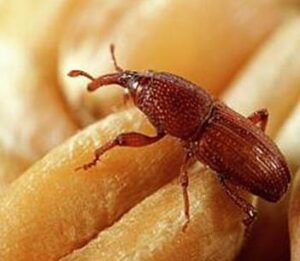
Insects that feed on and damage stored commodities such as grains and seeds can be divided into two groups. The first group of insects are INTERNAL FEEDERS. These insects spend most of their lives feeding within the kernel of grain. One example of an Internal Feeder is the Granary Weevil (Sitophilus granaries).
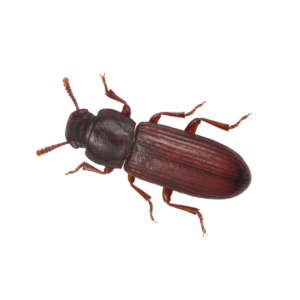
The second group of insects are EXTERNAL FEEDERS. These insects spend their lives feeding on the surface of grains and seeds or on the finished product itself, such as flour. One example of an External Feeder is The Confused Flour Beetle (Tribolium confusium) and is a major stored commodity pest problem.
Characteristics of the Confused Flour Beetle (External Feeder)
Colour – Red to dark brown in colour. Approximately 3 – 4mm in length.
Antenna – Antenna gradually thicken in size. There are 4 clubs on each antenna
Adult life span – 2 to 3 years
Amount of eggs female lays – 300 to 400 eggs in her lifetime, loosely in the food
Food – Feeds on broken grains, broken seeds, grain dust and processed food such as flour, dried fruit and spices etc.
Breeding – Breeding takes place between the temperatures of 20° Celsius and 37° Celsius. Optimum development occurs in the range of 32° Celsius and 35° Celsius
Flight – They cannot fly
External Feeder - Confused Flour Beetle
Internal Feeder - Granary Weevil
Comparing the Confused Flour Beetle and Red Beetle
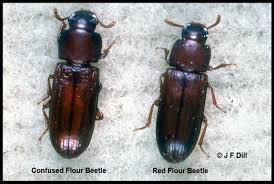
Signs of pest infestation in stored commodities
Heated grain, sharp smell and large volumes of dead beetles in the commodity, causes infested commodity to go mouldy.
Managing Confused Flour Beetles
Facilities where food commodities are kept should be built in such a way that they are easy to maintain and clean. They should be well insulated, well ventilated and damp-proof. Cracks and crevices, are harbourage places for The Confused Flour Beetle, as this is where grain dust settles and should be kept to a minimum.
The facility is to be maintained and cleaned on a regular basis with management carrying out regular inspections. Stacks of commodities are to be placed in a neat orderly fashion in the warehouse, packed onto pallets. Older stock is to be used/shipped out first.
Infested commodities are to be placed in a quarantine area, away from non-infested commodities to avoid cross infestation and fumigated as soon as possible with ProFume Fumigant.
Treatment
• The facilities themselves must be treated with a residual insecticide on a regular basis. Special attention should be given to cracks and crevices, corners, walls, beams and pallets.
The residual insecticide used must be registered for use in Food Commodity Storage Facilities.
The Labels instructions are to be strictly followed at all times.
- ProFume Fumigant – Fumigate food commodities using ProFume Fumigant.
- Food Commodities are registered to be fumigated making use of ProFume Fumigant (see label).
- Fumigating with ProFume Fumigant gives the warehouse manager/mill manager the luxury of having Food Commodities effectively fumigated over a 24 hour period.
- ProFume Fumigant kills the egg to the adult stage of insects.