Confused Flour Beetle Commodity Infestation

Your Stored Commodity Pest Guide

The warm, tropical climate of Africa is particularly conducive to stored commodity pests. The rate of insect proliferation in storage structures can be alarmingly high. In our continued effort to manage the problem effectively, we offer insight to pests we deal with throughout South Africa.

Internal and External Feeders

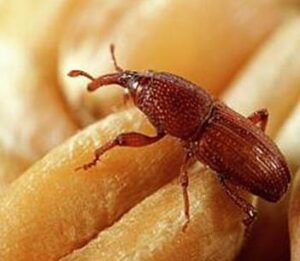
Insects that feed on and damage stored commodities such as grains and seeds can be divided into two groups. The first group of insects are INTERNAL FEEDERS. These insects spend most of their lives feeding within the kernel of grain. One example of an Internal Feeder is the Granary Weevil (Sitophilus granaries).

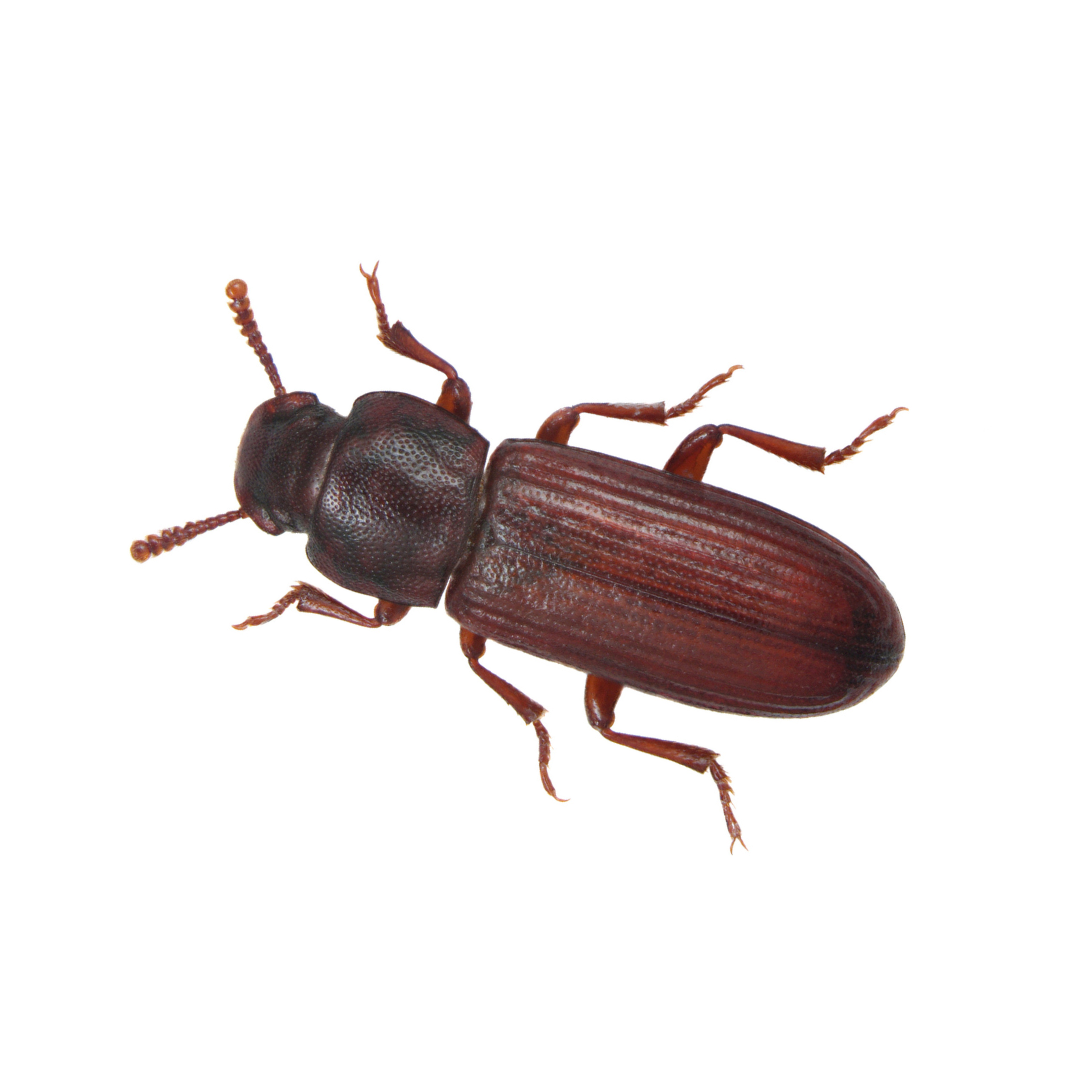
The second group of insects are EXTERNAL FEEDERS. These insects spend their lives feeding on the surface of grains and seeds or on the finished product itself, such as flour. One example of an External Feeder is The Confused Flour Beetle (Tribolium confusium) and is a major stored commodity pest problem.
The larvae continuously spin silk -like webbing over the surface forming a blanket over the infested commodity.

Characteristics of the Confused Flour Beetle (External Feeder)

Colour – Red to dark brown in colour. Approximately 3 – 4mm in length.
Antenna – Antenna gradually thicken in size. There are 4 clubs on each antenna
Adult life span – 2 to 3 years
Amount of eggs female lays – 300 to 400 eggs in her lifetime, loosely in the food
Food – Feeds on broken grains, broken seeds, grain dust and processed food such as flour, dried fruit and spices etc.
Breeding – Breeding takes place between the temperatures of 20° Celsius and 37° Celsius. Optimum development occurs in the range of 32° Celsius and 35° Celsius
Flight – They cannot fly

External Feeder - Confused Flour Beetle

Confused Flour Beetle Commodity Infestation
External Feeder Confused Flour Beetle (Tribolium confusium)

Internal Feeder - Granary Weevil

Internal Feeder Granary Weevil
Internal Feeder Granary Weevil (Sitophilus granaries)

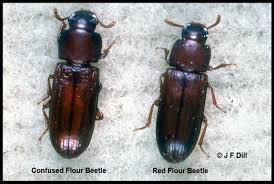
Comparing the Confused Flour Beetle and Red Beetle

Compare confused flour beetle and red flour beetle
A comparative look at the Confused Flour Beetle and Red Flour Beetle
Signs of pest infestation in stored commodities

Heated grain, sharp smell and large volumes of dead beetles in the commodity, causes infested commodity to go mouldy.

Managing Confused Flour Beetles

Facilities where food commodities are kept should be built in such a way that they are easy to maintain and clean. They should be well insulated, well ventilated and damp-proof. Cracks and crevices, are harbourage places for The Confused Flour Beetle, as this is where grain dust settles and should be kept to a minimum.

The facility is to be maintained and cleaned on a regular basis with management carrying out regular inspections. Stacks of commodities are to be placed in a neat orderly fashion in the warehouse, packed onto pallets. Older stock is to be used/shipped out first.

Infested commodities are to be placed in a quarantine area, away from non-infested commodities to avoid cross infestation and fumigated as soon as possible with ProFume Fumigant.

Treatment

• The facilities themselves must be treated with a residual insecticide on a regular basis. Special attention should be given to cracks and crevices, corners, walls, beams and pallets.

The residual insecticide used must be registered for use in Food Commodity Storage Facilities.

The Labels instructions are to be strictly followed at all times.

  • ProFume Fumigant – Fumigate food commodities using ProFume Fumigant.
  • Food Commodities are registered to be fumigated making use of ProFume Fumigant (see label).
  • Fumigating with ProFume Fumigant gives the warehouse manager/mill manager the luxury of having Food Commodities effectively fumigated over a 24 hour period.
  • ProFume Fumigant kills the egg to the adult stage of insects.